
Troublesome Creek flows for roughly 42 miles through Eastern Kentucky, winding its way through Perry, Knott, and Breathitt counties. Its headwaters begin at the confluence of the Left and Right Forks near Hindman, and its waters eventually empty into the North Fork of the Kentucky River near Haddix, just outside Jackson. Long before the arrival of modern industry and coal mining, the land surrounding Troublesome was settled by mountain folk and early pioneers. Around 1892, William Wolman described the headwaters as pristine, teeming with aquatic life and lined with banks of thick rhododendrons.
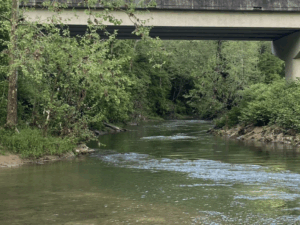 There’s something about wandering around in nature that helps a body sort things out. It grounds you and reminds you what life’s really about. As a young boy growing up in the hills of Eastern Kentucky, one of my favorite pastimes was playing in Troublesome Creek, just a short walk down the mountain from our home. The creek slipped like a green ribbon through the holler. My cousins and I would spend hours catching crawdads, minnows, soft-shell turtles, and mudpuppies. During spawning season, we’d go graveling for catfish, often pulling monsters from coal-truck tires or from deep up under the creekbank. While we were down there, my Uncle Shadetree McIntosh would grin and say, “Fellers, ya gotta get down there in and amongst ’um to get ’um.”
After my kin had gone back to town, I’d often fish alone for smallmouth bass with nothing but an old cane pole strung with decades-old cotton line and a JB Shiner bait from the ’90s. Time in that water gave me a deep love for the natural world, everything but gar and horseflies, and a sense of what I might call our hermetic connectedness with the earth.
I spent most of my childhood in that creek, Troublesome. And despite the tires and other debris it’s gathered over the years, I’ve no doubt it’s still just as beautiful as when Wolman saw it. I caught all kinds of creatures in those waters: salamanders, darters, freshwater mussels, snapping turtles (soft-shell and common), various sunfish, spotted bass, smallmouths, and probably some largemouth too. Not to mention more than a few species of catfish. These days, the banks are lined mostly with white oaks and tulip poplars, with a scatter of other hardwoods here and there.
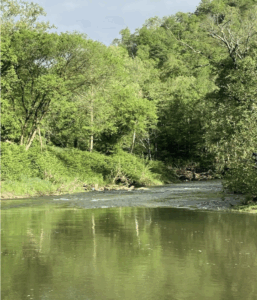 On a semi-related note, swinging bridges started appearing across Eastern Kentucky in the late 19th and early 20th centuries, born of necessity. Folks’ homes, schools, even whole communities were often on the far side of creeks like Troublesome, and a simple timber-and-cable span was the most reliable way to stay connected when the water rose. Many of those bridges are still standing. Their steel cables let them flex and survive floods better than stiff, brittle constructions ever could. Clay County alone once boasted over a dozen of them, though I don’t know why folks act like that’s some grand number. I can count at least thirty between Perry and Breathitt counties alone.
I have fond memories of my cousin Bub, who was terrified of swinging bridges. He’d beg his daddy, Toehead, to push him across in a wheelbarrow every day after school, back to their house on the other side of the holler. My buddy Charles Turner and I would laugh all the way home watching that. I was scared of them too when I was little, but as I’ve gotten older, I’ve come to love them. There’s something beautiful about their weathered boards and the way they hold on through every storm. They’re as tough and stubborn as the folks who built them and the ones who still cross them.
Getting back to fishing, Gierach notes in Chapter 19 of All Fishermen Are Liars that smallmouth bass are often touted as the next big thing in fly fishing. And I can see why. They’re striking fish, all golden-bronze and full of fight. Honestly, fly fishing for smallmouth on a little creek like Troublesome might be the perfect introduction to the sport for a redneck like me. Ever since I read that chapter about the Japanese fly rods, I’ve been thinking of cutting me an old cane pole and rigging it up myself with a few eye hooks and a Walmart fly reel. (All Fishermen Are Liars, chps. 13 & 19) I grew up along the stretch of Troublesome near Highway 476, right where Breathitt and Perry counties meet. That creek has always been central to life in the region, settled by folks like several of my great-grandparents who followed Daniel Boone through the Cumberland Gap. Though I was raised Mennonite, my people were originally Old Regular Baptists, staunch five-point Calvinists tied deep to the old country in both worship and temperament. If you ever hear Gaelic psalm singing and Old Regular line singing side by side, you’ll notice the resemblance. Troublesome ran right through the center of our lives in Rowdy. I remember stories from my great-grandpa Arnold about floating lumber down the creek from Fugate’s Fork to Haddix, back before Route 476 was built under FDR’s New Deal. One story that stuck with me was about the time a mule fell into the creek while they were working a logging site. It let out the most awful squeal, caught hypothermia, and drowned right there in the frigid water. A grim reminder, he said, of how Troublesome earned its name. My great-grandfather Arnold knows that creek like the back of his hand. He made his living logging its banks and hauling in massive flatheads and channel cats near Pigeon Roost, close to where the old Robinson Schoolhouse used to stand. He even swore he once caught a trout in there, which might’ve found its way in during a flood.
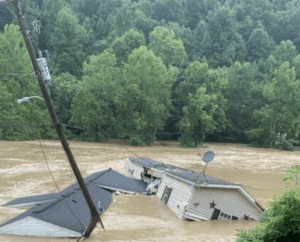
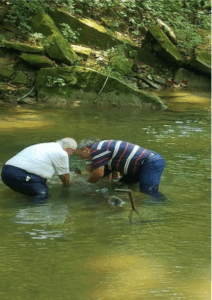 Baptisms still happen in the waters of Troublesome, same as they have for the past few centuries. There’s a photo of Bro. Eldon Miller and Bro. Gene Fugate baptizing folks below the Little Buckhorn Creek Mennonite Church, the very one I grew up in. Now, the steep foothills of the Appalachians, with their sandstone and shale, mean every drop of rain runs straight into the streams. That geography brings both beauty and devastation. In July 2022, what many called a “thousand-year flood” hit Eastern Kentucky. Over three days, more than ten inches of rain fell in places. The North Fork of the Kentucky River crested at a record 43.47 feet in Jackson. Thirty-nine lives were lost in Breathitt County alone, dozens more across the region. My mother lost her home and most of her animals in that flood. I lost family. It was a harsh reminder of how a beautiful creek can turn deadly in an instant. Coal mining has only made things worse. Surface mining and mountaintop removal in the North Fork basin have disrupted natural drainage and stripped the land of its vegetation, adding over six billion gallons of water to the watershed. As a kid growing up in Rowdy and over in Clayhole, I remember our house shaking from the blasting on the ridgelines.
And to top it off, a lot of folks still use what I call the “Kentucky straight pipe.” Wastewater runs straight from their homes into nearby creeks, including Troublesome. It’s a far cry from the old outhouse days. Now, runoff from abandoned strip jobs and untreated sewage continue to wash into the water, threatening the fish, the forest, and the families who call this place home.
 Despite the natural threats already facing Troublesome Creek and others like it, a new danger has emerged. The current Trump administration has aggressively rolled back environmental protections, reversing decades of hard-won progress meant to safeguard our ecosystems. By prioritizing short-term economic interests over long-term environmental sustainability, they threaten not just the health of our waterways, but our collective future as a species. In this critical moment in our nation’s story, it is vital that we, the citizens, speak out. We must advocate for the preservation of what has been accomplished and resist further harm.
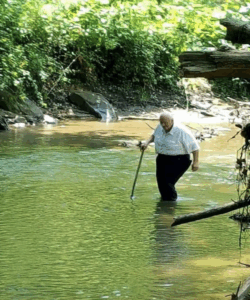 As the prophet Nehemiah once said, “I told them of the hand of my God that had been upon me for good… ‘Let us rise up and build.’ So they strengthened their hands for the good work.” Now is the time for us to do the same. We must strengthen our resolve and act—to make sure the good work done is not only protected, but carried forward, so that future generations too might enjoy fly-fishing for smallmouths on a quiet Kentucky creek. To close, I’m reminded of the last line in A River Runs Through It: “Eventually, all things merge into one, and a river runs through it.” That’s how I feel about Troublesome. My grief, my people, my past—all of it runs through them waters.


