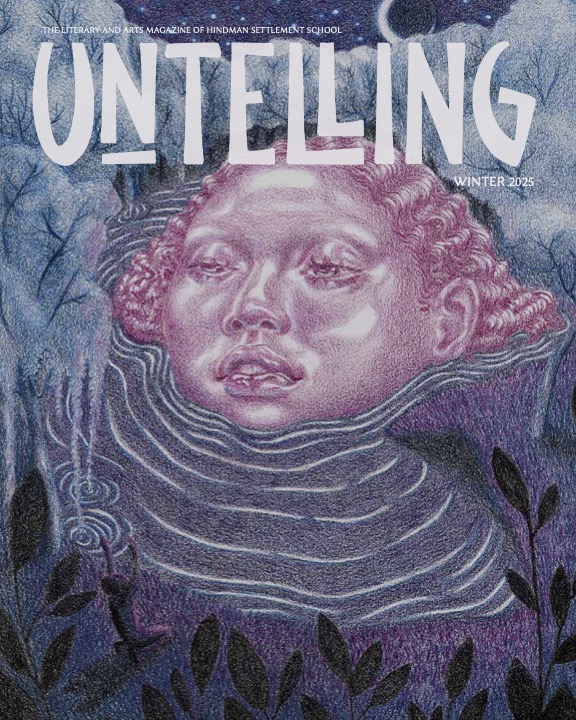
Untelling
UNTELLING
Sara Henning
She thought her dreaming / Made it so. –Brigit Pegeen Kelly, “Song” Wherever I am / I am what is missing. –Mark Strand, “Keeping It Whole”
If I could name the disc in my mother’s back that flamed in her those weekends she slept through the pitch black blasphemy of pain, when the kidney bean of her spinal disc slipped, its nucleus pulposis ringed by lamellae like the proud slash pine I knew her to be. If I could reach into my mother, trust her bands of early wood to bind what was once her nexus of strength. If I could unclutch her nerve from that disc’s vertebral arch, would I push like Sisyphus against his boulder? Would I push as I must have pushed against her, fetus baptized in amniotic fluid, baby me the size of a bell pepper, red flesh sheening over my own hush of seeds? Would I judder my feet against her cervix, punch her rib’s costal cartilage like a tiny boxer? Would I hide in her belly under tunics, balloon sleeves flaring, ashamed that my father was married to another woman? If I could name that flame that caused her to seize up as if in birth, as when my father shook terribly her earth, what would I call it?
*
My brain misfires fragments—if I, if I. The conditional tense offers a glory of hypotheticals, the heart lifting in hope’s syntax. Poverty does not. My childhood meant my mother in bed, darkness taking its darning needle to her Kmart nightgowns. My mother swallowing chasers of Diet Coke and tranquilizers stolen from my grandmother’s dog. Diet Coke and dog Valium, handfuls of Revco ibuprofen. I was ten. I was fifteen. I was the heart-smashed daughter grasping the handle of our purple Bissell, scrubbing the Pangea of rust and shit from our toilet bowl. Guilt is not a verb. It is bone psalm. From my well of housework, supper bowls of Rice Krispies drowning in milk, I trusted the God of nothingness to hear my prayers: Save my mother. Save me.
*
Twenty-five, I splayed on threadbare carpet as if I were a child again, too old to make angels in rare Georgia snow. I had fallen. My boyfriend’s steady stream of fuck you’s like contusions damning my skin. I don’t have to tell you that my shoulders were a kintsugi of bruises. I don’t have to tell you I often dreamed I was one of my mother’s Raggedy Ann dolls, red yarn stitched to my skull. Smile stitched to my face. Raggedy Ann, arms bent in gauche angles, dust bunnies lacing her hair. Raggedy Ann death-still in a closet, a canopy of t-shirts engulfing her from plastic hangers, her knees grazing the raw-edge hems of jeans. I was always falling. He was always yelling. When the trains came blazing, their stream of graffiti coloring the backs of my eyelids, I pretended they resurrected my name. Sara was here glazed in aerosol. Indigos, violets like the end of a rainbow. I didn’t know the trains were pain screaming through my body. I thought my dreaming made them so.
*
I’m too stupid to decode my mother’s pain. No, I’m too chicken shit. Ten years ago, her coma switchbacked under a syringe driver of morphine, subcutaneous infusion shushing her agony. How much of her was cancer, bilirubin rushing her blood as her liver shut down? How tiny a slice of my mother was left, a purgatory of sleep thieving her last words? Before she signed hospice papers, how many nights did she pace her living room, fearing the call of sleep meant death? When life escaped her mouth in moans, in half-breaths, jaw clenched against the good Lord taking her, her nurse called it agonal breathing. I called it my untelling.
*
Now, my untelling radiates down my sacrum and into my right thigh, my lumbosacral nerve root compressed like a suspension coil spring. I wake in the night, my legs on fire. By morning, numbness preaches my body’s gospel. My doctor calls it acute sciatica. I call it bodily erasure. I’m not very good at science. I’m not very good at suffering. Wherever I am, I am what is missing.
*
Tell me, how does an I turn into a was? How does a slash pine turn from mother to ash? How does an I forgotten turn into an I delivered? That’s the only untelling I would give anything—yes, anything—to know
Sara Henning is an award-winning teacher and poet. She is the author of the poetry collections Burn (Southern Illinois University Press, 2024), a Crab Orchard Series in Poetry Editor’s Selection; Terra Incognita (Ohio University Press, 2022), winner of the 2021 Hollis Summers Poetry Prize; and View from True North (Southern Illinois University Press, 2018), winner of the 2017 Crab Orchard Series in Poetry Open Competition Award and the 2019 High Plains Book Award. She teaches at Marshall University, where she coordinates the A.E. Stringer Visiting Writers Series.