

This update was prepared by Sarah Insalaco, Flood Recovery Archivist.
Agricultural Education and the Birth of the Foodways Program at Hindman Settlement School
 When Katherine Pettit and May Stone arrived in Hindman, Kentucky, in the summer of 1900, they intended only to stay for a season, bringing their traveling work of mountain “settlement” education to one more Appalachian community. Instead, they found a calling rooted in the soil, spirit, and stark need of the Eastern Kentucky mountains. Surrounded by rugged hills and isolated homesteads, Pettit and Stone saw poverty, illiteracy, strength, dignity, and a deep cultural heritage waiting to be nurtured. That summer gave way to something permanent: the founding of Hindman Settlement School, the first rural settlement school in the United States. Built on the belief that education should serve the whole person, Hindman Settlement School’s premise combined traditional academics with practical training, teaching reading, writing, and arithmetic alongside agriculture, health, home economics, and Appalachian crafts. The school aimed not to “fix” mountain people, but to empower them—to cultivate a form of learning rooted in place, tradition, and the belief that the region’s future could be shaped not from the outside, but from within.
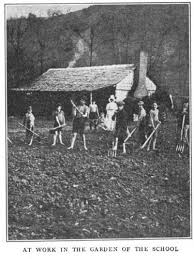
Agriculture was a cornerstone of mountain life in Eastern Kentucky. Most families relied on small subsistence farms and often faced seasonal food shortages, making farming a tradition and a vital means of survival. At Hindman Settlement School, agriculture was both a practical necessity and a central pillar of its educational philosophy. Students, staff, and local families worked collaboratively to cultivate the land, raise livestock, and adopt farming techniques suited to the region’s rugged terrain. This hands-on labor fostered self-sufficiency, responsibility, and environmental stewardship values—principles deeply embedded in Appalachian culture. However, while local farms produced limited food and livestock, the school’s founders quickly observed that many traditional methods were inefficient and at risk of vanishing. In response, Hindman established its Agricultural Program through an early partnership with the State Agricultural Extension Service (SAES). It provided up-to-date farming knowledge and distributed seeds to students, nearby farmers, and the school.
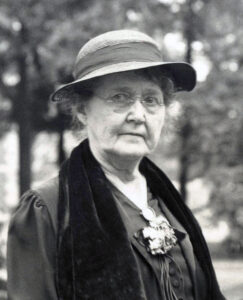
Around this time, author and early staff member Lucy Furman was appointed groundskeeper. Recognizing the potential of the land, she enlisted the help of John C. Campbell, a noted social reformer affiliated with the Russell Sage Foundation. Together, they plowed the school’s barren hillsides and demonstrated how informed agricultural practice could transform even the most unyielding soil. Under Campbell’s guidance and support from the Russell Sage Foundation, Hindman became one of the region’s designated State Experiment Stations. With their leadership, the once-infertile hills were converted into some of the most productive farmland in the county, turning Hindman into an educational institution and a model of agricultural innovation for the Appalachian South. In the Summer of 1911, the girls planted cow peas, soy beans, rye, and clover, which helped rejuvenate the soil and were used for silage. The Settlement believed in teaching by example; the State Experiment Station recognized this and donated all seeds. With this donation, the students planted hundreds of fruit trees and berry bushes, and they learned how to use livestock and pasture the field for another growing season.
With the emerging farm and the plethora of produce it was churning, the school decided to host the first Knott County Fair in the Summer of 1910, this was a way for the students to show their work, win prizes for the produce they grew and the livestock they raised, two girls won awards for the corn and potatoes they grew.
By 1916, Hindman Settlement School recognized the pressing need for extension workers to support its expanding educational and community programs. Located in a remote Appalachian region with limited access to modern resources, the school served a population facing persistent poverty, geographic isolation, and outdated farming practices. Extension workers could bring updated agricultural techniques, home economics training, and public health information directly to local families, otherwise inaccessible resources. Moreover, the school often operated with limited funding and staff, making it challenging to meet the community’s growing demands alone. Extension workers, supported by outside agencies or state programs, offered a cost-effective way to broaden the school’s impact without placing additional financial strain on its budget. Their presence promised technical expertise, a sustainable path toward self-sufficiency, and improved quality of life for the region.

The Southern Industrial Educational Association piqued May Stone’s interest. This extension program was established in 1905 by Martha Gielow, an Alabama native and self-made woman, who saw promise in the heart of Appalachia. SIEA was founded to support rural education initiatives in the South, particularly those emphasizing practical training, agricultural improvement, and industrial arts. By aligning with the SIEA, Hindman gained access to a broader network of supporters and national visibility, which helped legitimize and sustain its mission. This relationship enabled the school to enhance its agricultural and domestic science programs, attract skilled teachers, and provide more comprehensive services to the Appalachian community it served. The partnership marked a turning point, transitioning Hindman from a purely local initiative into a nationally recognized rural education and community development model.
With the partnership formed between Hindman Settlement School and the Southern Industrial Educational Association (SIEA), extension worker Anna Van Meter was sent to lead a four-week Extension Course from February 14th to March 11th. For a modest fee of two dollars, Van Meter provided instruction in agriculture, teaching young girls essential skills such as planting, seed rotation, and basic canning techniques. Her curriculum extended beyond farming to include training in sewing, cooking, and nursing skills crucial to self-sufficiency in the rural Appalachian context. The success of the course quickly revealed a broader, ongoing need for this kind of instruction. Recognizing her value, the Settlement and the SIEA agreed to keep Van Meter on full-time. Over the next few years, she left a profound and lasting legacy. She established a garden club where each girl cultivated a tenth of an acre, fostering independence and pride in providing food for their families. She also launched a canning club far beyond the school grounds, teaching women from Hindman and the surrounding hollers how to preserve food safely. These clubs became so popular that an annual friendly competition emerged. Whoever grew and canned the most produce would win, turning education into a community celebration of resilience, resourcefulness, and skill. Canned food didn’t just benefit the Settlement; the surplus was donated to families throughout the county, further extending the school’s impact and reinforcing its mission of service to the region.
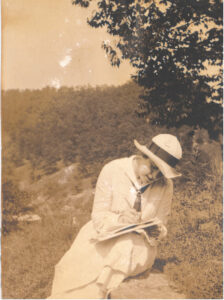
Anna Van Meter quickly recognized that the need for canning instruction extended well beyond Hindman Settlement School’s campus boundaries. She would rise well before six o’clock on canning days, pack two saddlebags with Mason jars, aprons, and towels, and set out on a mule bound for a remote holler. Upon arriving, she would assist the household women in gathering vegetables from their gardens and set up an outdoor canning station where neighbors could observe and learn. By the end of a full day’s work, Van Meter and the women often managed to can more than 40 jars—preserving beans, tomatoes, corn, apples, berries, and sweet potatoes. On one such visit, she was approached by an elderly widow who asked if she might learn to can or purchase preserved goods. Van Meter had previously limited instruction to homes with daughters, but the quiet resolve and disappointment in the woman’s eyes moved her to make an exception. She taught the widow how to can, and the woman paid her in chickens in exchange. That moment underscored the broader impact of Van Meter’s work and her willingness to adapt her mission in response to the community’s needs.
During her time at Hindman Settlement School, Anna Van Meter traveled nearly two thousand miles on horseback to help the people of Knott County. Many students, faculty, and community members loved her. What Anna Van Meter accomplished after leaving Hindman Settlement School remains unknown, as her promising career was abruptly cut short when she contracted the Spanish Influenza in 1918. Forced to retire due to illness, the historical record grows quiet on her life beyond that point. Despite the lack of information about her later years, her legacy at Hindman endures, shaped by her tireless dedication to education, community uplift, and the empowerment of Appalachian women and girls through practical skills supporting household and regional resilience.
As the years passed and times changed, Hindman Settlement School gradually began to phase out its formal Agriculture Program, shifting away from the once-central model of self-sustaining farming foundational to its early mission. Modernization, changing educational priorities, and evolving community needs all played a role in this transition. The barns that once housed livestock grew quiet as the animals were either sold or passed away, and the fields once cultivated by students and staff were slowly sold off or repurposed. While the traditional model of agricultural instruction faded, it became increasingly clear that the core values embedded in the program—self-reliance, nutritional education, and cultural preservation—still held immense relevance. Out of this realization grew a renewed focus on foodways. This program honored the region’s culinary traditions while addressing contemporary concerns such as food insecurity, sustainable practices, and cultural heritage. The Foodways Program became a natural evolution of Hindman’s agricultural roots, combining Appalachian cooking traditions with hands-on learning and community engagement. Through workshops, storytelling, and celebrating heirloom recipes, the program continues to nourish both body and spirit, preserving the past while adapting to the present. In this way, Hindman’s legacy endures as a school and a living thread in the fabric of Appalachian life, where education and tradition continue to walk hand in hand.


