This historical update was prepared by Sarah Insalaco, Flood Recovery Archivist.
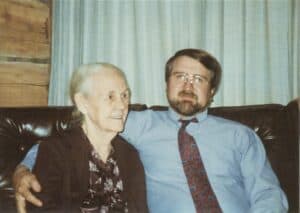
“When I count my children
I alway get it mixed,
I only gave birth to five
But Mike says he’s number six.
You say he must be adopted
I don’t see how that can be.
I don’t remember adopting him,
But he might’ve adopted me.
I tried to tell his mother
It was all just in fun
She said, “He can be your number 6,
But he’s still my number one.”
-Verna Mae Slone
Walking through the campus of Hindman Settlement School, one can’t help but feel an ethereal presence – a lingering aura that speaks of dedication, vision, and community. This palpable energy is none other than the enduring spirit of Mike Mullins, a man whose influence transcends the tangible structures and landscapes around him. Mike’s presence on campus is more than just a memory; it’s a living force that resonates in the rustling leaves and whispers through the corridors of the institution. His commitment to education and community development has become an integral part of the school’s identity, shaping the atmosphere with an essence of resilience and aspiration. In every corner, one can sense the echoes of Mike’s footsteps, echoing the strides he took to elevate the Hindman Settlement School to new heights. The very air seems to carry the weight of his passion for learning and community building, creating an environment where students and staff alike are inspired to embody the values he championed.
On March 25th, 2024, Mike Mullins is set to be posthumously honored with the Kentucky Literary Impact Award for his significant contributions and enduring legacy within the annual Appalachian Writers’ Workshop. Born in the tight-knit community of Hi Hat, Floyd County, Kentucky, on June 22, 1948, to Herman and Mildred Dawson Mullins. Raised in the shadows of a coal miner’s family, Mike shared a special bond with his father, who, amid the challenges of the mines, imparted upon him the values of education and hard work. It was during his formative years, in the sixth grade, that Mike’s trajectory was altered. A dedicated teacher introduced him to the possibilities awaiting at Berea College, etching an indelible mark on his young mind. The resonance of that influential teacher’s impact endured within Mike, propelling him with newfound determination to seek higher education. Consequently, he applied and secured admission to Berea College. It was during his time at Berea that he encountered the insightful teachings of Loyal Jones, which introduced him to the profound concept of Appalachia.

Amid the academic pursuits at Berea, another significant chapter unfolded in Mike’s life. Love blossomed as he crossed paths with Frieda Mae Smothers, culminating in an elopement during Mike’s pursuit of graduate studies at the University of Cincinnati. Stepping into the realms of higher education, Mike earned his Master’s in American History, solidifying his academic foundation. The couple’s journey came full circle as Mike and Frieda returned to Eastern Kentucky. A pivotal chapter in Mike’s career commenced as he assumed a role at Alice Lloyd College. Here, he took charge of the Appalachian Oral History project, a role that would become instrumental in documenting and preserving the rich narratives of the region. In these pivotal moments, Mike Mullins not only forged his academic path but also laid the groundwork for a lifetime dedicated to the cultural and historical tapestry of Appalachia.
Mike led the project at Alice Lloyd for about five years, until a shift in leadership prompted him to look for other endeavors. With the connections at Berea, he got word that the current executive director was resigning, and that the director position had opened. Mike and seventy other people applied, but ultimately in a 7-5 vote, Mike secured the job. He arrived on campus in October of 1977, and took over on December 1st.
Upon Mike’s arrival at Hindman Settlement School, he encountered several challenges. Firstly, at the age of 29, doubts lingered among board members regarding his suitability for the role, especially following Elizabeth Watts’ tenure. Additionally, the campus required numerous repairs, and decisions had to be made regarding other programs and initiatives that HSS wished to undertake. Mike promptly initiated various plans to revitalize HSS, aiming to secure its future for generations to come. HSS had transitioned from being a standalone school to serving as a supplement to county schools, leaving its role in limbo. Mike was determined to define the Settlement School’s position within the community. While there were certain actions he desired to take, he questioned their necessity for the Settlement.
The community played a pivotal role in the inception of two programs. The genesis of the adult education initiative stemmed from a woman’s desire to learn to read her Bible. Mike, in response to this, hired the wife of a staff member to tutor her. As word spread, more individuals expressed interest in adult learning and GED services. Recognizing the community’s needs, HSS collaborated with the Mennonite Central Committee to enlist volunteers for the program. Subsequently, HSS merged this initiative with a local program receiving state funding, leading to the establishment of the Knott County Adult Learning Center, which continues to operate successfully. The second community-driven program is the Dyslexia program, which has thrived for four decades. Prior to the Americans with Disabilities Act (ADA), there were no special education services available in public schools for students with learning disabilities until 1990. Since the enactment of the program, thousands of children from Eastern Kentucky have received the assistance they deserve.
The literary tapestry of Hindman Settlement School is intricately woven with the vibrant threads of the renowned Appalachian Writers’ Workshop. Initiated by the visionary author Albert Stewart in the year 1977, the workshop began as a modest gathering, drawing together a community of twenty-five to thirty individuals who shared a passion for literature and a connection to the Appalachian region. Albert Stewart, fueled by a commitment to literary enrichment, dedicated several years of his life to nurturing the workshop, fostering an environment of support and creative collaboration.
Albert Stewart’s leadership and tireless efforts laid a sturdy foundation for the Appalachian Writers’ Workshop, propelling its growth and significance within the cultural landscape of Hindman Settlement School. Recognizing the workshop’s potential to serve as a dynamic platform for literary exploration, collaboration, and celebration, Stewart eventually decided to pass the leadership reins to Mike, a successor who shared his passion for the written word.
Under Mike’s stewardship, the Appalachian Writers’ Workshop evolved into a cornerstone of Hindman Settlement School’s cultural identity. Mike’s deep affection for the workshop extended beyond its regional roots, appreciating how it brought together not only local talents but also national literary enthusiasts. He found joy in the workshop’s success, attributing it to the collective efforts of dedicated individuals who played pivotal roles in bringing this literary tradition to fruition.
Mike, in acknowledging the workshop’s success, generously credits those who contributed to its growth, emphasizing their role in shaping the credibility of Hindman Settlement School. The Appalachian Writers Workshop stands as a living testament to the school’s unwavering commitment to nurturing and preserving the rich literary heritage of the Appalachian community.
As the workshop continues to thrive, it serves as a dynamic force, attracting writers and literary enthusiasts from far and wide. Beyond being a week of literary exploration, the workshop has become a catalyst for the exchange of ideas, the forging of lasting literary connections, and the celebration of the diverse voices that contribute to the rich tapestry of the Appalachian literary tradition. It remains a living embodiment of Hindman Settlement School’s enduring dedication to fostering creativity, community, and the enduring power of storytelling.
In reflecting on Mike’s legacy, it becomes evident that his passion for Hindman Settlement School extended beyond mere employment. If money were not a necessity, Mike would have run the school for free, a testament to his deep love for his job and the community it served. His tenure of over thirty years came to a tragic end with his sudden passing from a heart attack in 2012, leaving a void that echoes his absence. As we walk through the halls of Hindman Settlement School, we honor Mike Mullins not only for his professional achievements but for the enduring impact he had on the lives of those he touched. The Literary Impact Award is not just a recognition of past contributions; it is a celebration of a life dedicated to the relentless pursuit of education, community, and the preservation of Appalachia’s rich cultural tapestry. Mike’s legacy lives on, not just in the physical structures of the school but in the hearts and minds of all who continue to be inspired by his remarkable journey.


